Laminate Veneers
VENEERS
OR
zirconia?
- Written by
- Dr. Dt. Şeyma Kılıçarslan
- Published
- Last reviewed
Patients researching treatment in Istanbul are usually presented with these two as a choice between a premium option and a budget one, or between a natural-looking result and a durable one. Neither framing is accurate.
They are different treatments for different situations, and in most cases the state of the tooth decides which is appropriate before appearance enters the conversation at all.
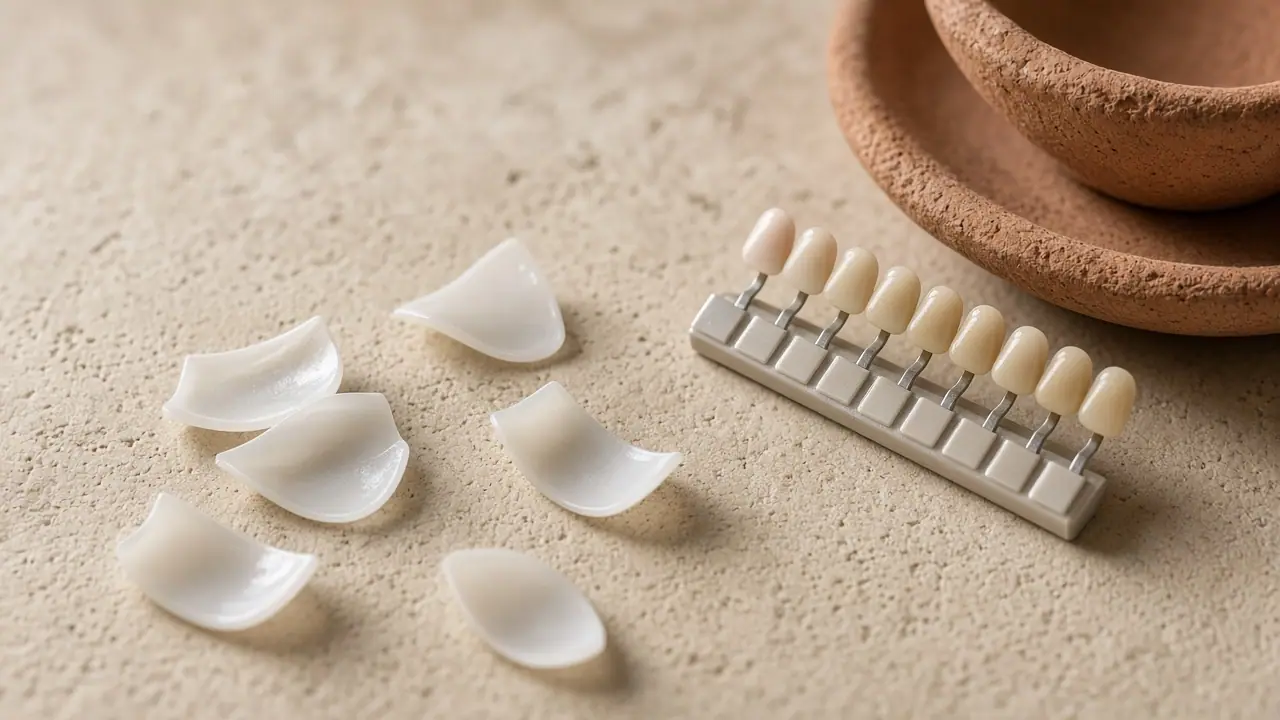
The difference that matters
A laminate veneer covers the front surface of a tooth and, usually, its biting edge. A zirconia crown covers the entire tooth on every surface.
That single structural distinction determines almost everything else: how much healthy tooth has to be removed, which teeth are candidates, and how the restoration behaves over time.
The tooth decides, not the appearance
The most common misconception is that this is an aesthetic choice. It is usually not.
A tooth that is structurally sound — no large fillings, no root canal treatment, no fracture — and simply needs its shape, proportion or colour changed is a veneer case. Preparing that tooth for a crown would mean removing healthy structure on every surface to solve a problem confined to one.
A tooth that has already lost significant structure is generally not a veneer case. There may be too little enamel left for a reliable adhesive bond, and the tooth may need the reinforcement full coverage provides.
Which looks more natural
Thin glass ceramics transmit light in a way that closely resembles enamel, and can be layered to reproduce the variation in translucency between the gum and the incisal edge. This gives veneers an advantage in the front of the mouth, where that behaviour is visible.
Zirconia has historically been more opaque. Multilayer and high-translucency formulations have narrowed that gap considerably, and a well-made zirconia crown in the front of the mouth is not obvious.
In practice, the quality of the technician’s work and the accuracy of shade selection account for more of the difference than the material does.
Strength and where each is used
Zirconia is substantially stronger. That is why it is used for back teeth, for bridges spanning a gap, and for patients who grind. It is also used where a tooth needs to be rebuilt entirely.
A veneer is not weak — bonded porcelain is well supported by the tooth beneath it — but it is thin, and it is bonded rather than encircling. Under heavy or repeated lateral forces it is the more vulnerable of the two.
Most full cases use both
Treating a whole smile with one material because it is simpler to quote is a commercial decision rather than a clinical one.
A realistic plan usually places veneers on the teeth that are sound and crowns on the ones that are not, then matches them so the transition is invisible. Matching two different ceramics across adjacent teeth is more demanding than using one material throughout, which is precisely why some practices avoid it.
What to ask at a consultation
- Which of my teeth are structurally sound, and which are not?
- For each tooth being treated, how much preparation does the plan involve?
- Why this material for this tooth rather than the alternative?
- Is there an option that removes less tooth structure, including doing nothing?
- Can I see the proposed shape before any preparation begins?